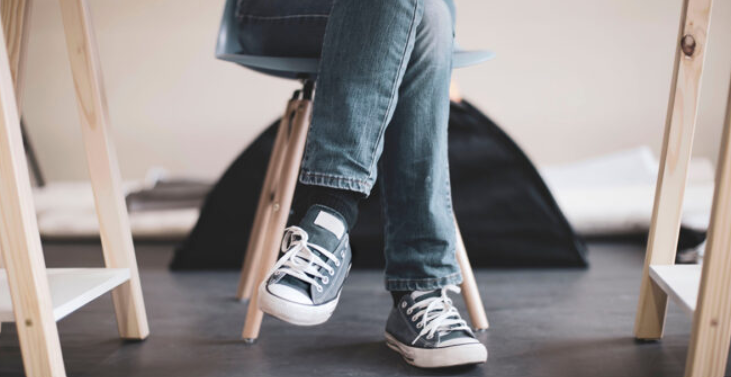
When a woman crosses her legs, it’s more than just a habit—it’s a subtle expression of confidence, comfort, and social awareness. Rooted in psychology and shaped by generations of cultural influence, this simple gesture can reveal far more than it seems.
Let’s explore the subtle psychological cues and centuries of cultural conditioning behind this timeless pose.
A pose with a past
Long before ergonomic chairs and pantsuits, the way women sat was seen as a reflection of social grace and femininity. In the 19th century, women were often expected to sit with their ankles crossed or legs positioned modestly to one side—crossing at the knees was considered improper in many circles.
Fast forward to the 1960s—fashion icons like Audrey Hepburn and Jackie Kennedy redefined elegance with crossed legs, often paired with stylish heels. It wasn’t just posture—it symbolized power and poise.
Today, leg-crossing remains a common element of modern female body language, but now it serves a broader range of psychological and social purposes.
Psychology behind the pose
While it may seem like women cross their legs simply for comfort, experts say there’s more to it.
Nonverbal communication
Body language experts agree that crossed legs are a form of nonverbal communication.
“The legs and feet are among the last body parts we consciously control, so they provide valuable insight into what someone is really thinking, their attitudes, and how [a woman] feels,” Katia Loisel, an Australian-based dating and body language expert, told Men’s Health.
Depending on the direction the legs are crossed—toward or away from someone—it can signal openness or defensiveness.
Toward someone: interest, comfort, connection.
Away from someone: detachment, disinterest, discomfort.
“We point our feet and legs toward what we like and away from what we don’t,” Loisel says, adding that their direction speaks volumes.
Subconscious modesty
Let’s face it—fashion hasn’t always been practical. When wearing skirts or dresses, crossing the legs can be a subconscious way to maintain modesty, especially in public or professional settings. It’s a gesture deeply rooted in etiquette, even though modern clothing allows for more freedom.
Self-comforting
Interestingly, psychologists note that crossing your legs can also act as a self-soothing behavior. It creates a sense of boundary and helps claim personal space—especially in crowded or unfamiliar environments.
Professional and personal situations
In the workplace: In professional settings, crossing legs at the knee or ankle often reflects confidence and control. It’s a common posture in boardrooms and interviews. However, excessive movement, like bouncing or constantly shifting, may signal anxiety or impatience.
For those in leadership roles, sitting with one ankle resting on the opposite knee—sometimes called the “figure-four”—is a more assertive, traditionally masculine posture. While fewer women adopt it, those who do often project boldness.
Casually with friends: In relaxed settings, leg-crossing becomes less formal and more about comfort. Think slouched posture or casually draped knees—here, body language reflects ease and openness rather than precision or poise.
On a date: In this context, leg-crossing can play a role in flirtation. Crossing toward someone shows interest and attentiveness, while slower movements—like uncrossing and re-crossing—can be interpreted as subtle flirtation, all without saying a word.

Powerful language
While comfort is certainly a factor, it’s clear that crossing legs is also a powerful, silent form of communication—expressing everything from confidence to caution, modesty to mood. Whether at work, at brunch, or waiting for the train, women across the world continue this gesture, often without thinking—yet it carries meaning.
So the next time you notice someone crossing their legs, remember—it’s not just posture. It’s personality in motion.