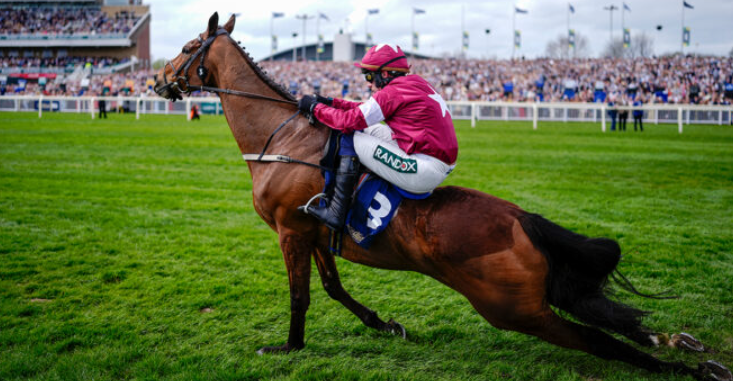
The final seconds of Gold Dancer’s race have left viewers shaken after the young horse dragged his back legs across the finish line before collapsing shortly after at the Aintree Festival.
On April 10—just one day before Get on George, 6, died at the same event—spectators watched in horror as 7-year-old Gold Dancer pushed forward with a whip striking his back, despite a painful landing over the final fence.
Sadly, the effort ended in tragedy only moments after the horse secured victory in the Mildmay Novices’ Chase.
Horse whipped across finish line
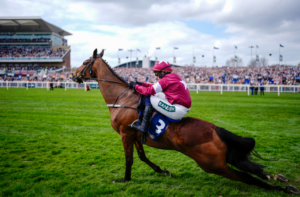
Gold Dancer had been running strongly approaching the last obstacle when the stumble changed everything. His hindquarters slipped sharply on landing, forcing his back legs out to the side in a movement that immediately raised concern among those watching closely.
“The horse jumped and slipped and lost his back end,” James Given, director of equine health and welfare for the British Horseracing Authority (BHA), told the BBC. “He came up very quickly, took one half stride to get organised, and galloped away.”
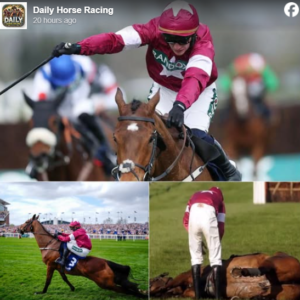
Despite the misstep, jockey Paul Townend continued to whip Gold Dancer toward the finish line, with the racehorse winning by four lengths before the true extent of the injury became clear moments later. Within seconds, the rider dismounted and veterinary teams rushed in, raising screens to block the scene from public view.
What happened behind the screens
“The horse had collapsed and was unable to rise,” Given reportedly said, explaining there was a fracture in the animal’s “lumbar region.”
Sadly, Gold Dancer’s injuries were too severe to treat, and behind the screens, the gelding was euthanized.
“He’s been put down. He broke his back. It’s terribly sad for the horse,” said Eddie O’Leary, racing manager at Gigginstown, who owned Gold Dancer. “What could Paul Townend do? He felt fine—it was only when he pulled up that something was wrong.”
Jockey didn’t ‘notice that injury at all’
The incident prompted a standard stewards’ inquiry to review whether there had been any indication the horse was seriously injured before completing the race.
According to the BHA, it was determined that Gold Dancer’s stride appeared balanced as he continued running.
“The horse stayed as straight as an arrow and wasn’t deviating off a straight line or showing asymmetry; the back legs were following the front legs exactly,” said Given, who was part of the inquiry. “It was only when they went past the finishing line that he turned to the left as the track goes, shifted from a canter to a trot, and the action changed, and Paul [Townend] became aware.
“He immediately jumped off and was attended by the vets. I don’t believe Paul was able to notice that injury at all,” Given said, adding that Townend told stewards that “all a jockey can do is go on how the horse feels, and the horse felt normal to him.”
Following the review, stewards confirmed that Townend would not face disciplinary action.
‘One of the most hazardous events in the world’
The death has renewed criticism from animal welfare organizations, which argue that jump racing exposes horses to unnecessary danger due to the physical demands involved.
People for the Ethical Treatment of Animals (PETA) described the Grand National as “one of the most hazardous events in the world,” citing the combination of distance, speed, and high fences as contributing factors to serious injuries.
According to Animal Aid, 76 horses have died during the festival since 2000, including 4-year-old Willy De Houelle and 13-year-old Celebre d’Allen—both killed at the event in 2025.
And on April 11, 2026, Get on George, 6, also died on the course. “Jump races are extremely dangerous for horses. Falls often result in broken necks, shattered limbs, spinal injuries, or fatal internal trauma. If their injuries don’t kill them immediately, horses are typically euthanized on site or later that day,” PETA wrote in a statement.
Horses dying for ‘a cheap bet’
“Deaths at Aintree are not freak accidents—they are foreseeable consequences of a race designed to be extreme to attract gambling revenues, sponsorship, and viewers,” PETA argued.
Emma, chief executive at the League Against Cruel Sports, echoed that sentiment, urging people to “boycott the Aintree Festival” and “refuse to bet on racing,” which “glosses over animal cruelty.”
“Year after year, we see horses dying at Aintree for people’s entertainment and a cheap bet. Sadly, Gold Dancer is the latest victim of this heartless spectacle, which flies in the face of animal welfare,” Slawinski told the BBC.
“If the same harm were inflicted on animals in any other context, it would be widely condemned as abuse,” PETA added.
Gold Dancer’s final strides have become part of a wider conversation about the balance between tradition and animal welfare in professional racing.
Do you believe events like this highlight animal abuse for entertainment, and would you consider boycotting races where horses face such risks? Share this story to raise awareness and encourage discussion about how racehorses are treated in competitive sport.